Culture is the Catalyst – What Fighting Wildfires Teaches Us About Mission Success Under Pressure
By Tony Barrett | February 12, 2026
When a wildfire breaks out, there is no easing into the moment.
The air changes. The radio crackles. Visibility drops. Decisions that normally take hours suddenly need to happen in seconds. Every pause carries weight, because people, property, and entire communities are on the line.
There is also no luxury of perfect information. What takes over is trust. Not blind but earned trust. Trust in the people beside you. Trust in the way you have trained. Trust that the systems supporting you will do what they are supposed to do when things get hard.
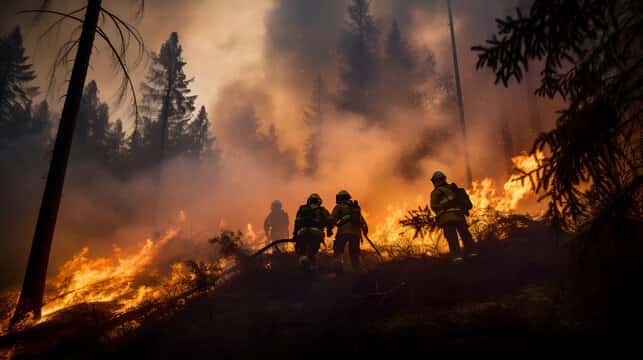 Within minutes, crews are moving. Smokejumpers drop into rough terrain. Hotshot teams hike for miles with heavy packs. Aircraft circle overhead, timing their drops with precision that only looks effortless from a distance.
To an outsider, it can look chaotic.
To the people inside it, it feels focused. Intentional. Almost quiet in its own way.
That is not an accident. It is culture at work.
Trust in People
Firefighters operate in a world where uncertainty is constant. Winds shift. Fire behavior changes without warning. Conditions that felt manageable one moment can become dangerous the next.
When the call comes, they respond with calm urgency. Not because the situation is safe, but because they trust one another. Every firefighter knows that their actions matter, not just for themselves, but for the entire crew.
If one person misses a step, others feel it. If someone hesitates, it ripples. When one person moves with confidence, it gives everyone else room to do the same.
That kind of trust is built over time. It comes from shared experience, hardship, clear expectations, and a deep sense of accountability. Crews do not just train for tasks. They train to understand how each role fits into the whole. They learn to read one another, communicate clearly, and make decisions that serve the team, not the individual.
That is culture doing its job. It creates alignment before the pressure hits.
At Allyon, we see this same dynamic play out across the Federal missions we support. Strong performance is not the result of heroics. It comes from people who know what is expected of them, trust the people around them, are well-trained, and feel confident acting when it matters. That confidence is designed, not assumed.
Trust in Process
During California’s 2018 Camp Fire, one of the deadliest wildfires in U.S. history, firefighters relied heavily on closed loop communication. Orders were spoken, repeated back, and confirmed before action was taken.
It may sound simple, but in smoke, noise, and urgency, that discipline saved lives.
That process was not about control. It was about clarity and efficient expenditure of resources. It ensured that everyone heard the same thing and moved together, even when conditions were deteriorating fast.
Wildfire response depends on systems like this every day. Clear communication. Defined roles. Training that turns deliberate practice into instinct. These processes exist to support people, not slow them down.
The same principle applies to the work we do at Allyon. Good processes are not about checking boxes. They are about removing friction. When people trust how work is designed, they spend less energy navigating uncertainty and more energy focused on the mission itself. Preparation shows up as elite performance when it counts.
Trust in Systems
Behind every wildfire response is a network most people never see. Dispatchers coordinating resources. Pilots working in sync with ground crews. Logistics teams making sure supplies arrive where they are needed, often miles from the nearest road.
Technology plays an important role. Mapping tools, communication networks, and data all help people make better decisions faster. But none of it works in isolation.
Systems succeed only when people trust them and understand how to use them. When information flows clearly, firefighters can act with confidence. When systems get in the way, they create hesitation (or worse – inaction) at the worst possible time.
The same is true for Federal missions. Systems should make collaboration easier, not harder. They should support decision-making, not replace it. At Allyon, we design systems with one goal in mind: helping people do their best work together, especially when the stakes are high.
Culture: What Holds When Everything Else is Under Pressure
Whether on a wildfire line or supporting complex Federal missions, success rarely comes down to one decision or one tool.
It comes down to trust.
Trust built through people who know and respect one another.
Trust reinforced by processes that create clarity under pressure.
Trust sustained by systems designed to support and enhance human performance.
That is what culture does.
It acts as the catalyst when things get hard and the mission matters most.
At Allyon, we build with that belief at the center. When people trust one another and trust the structures around them, they do more than get through the mission. They deliver superior results that endure.
###
About the Series
Culture is the Catalyst is a leadership series grounded in a simple, fundamental belief that has shaped Allyon President and Chief Strategy Officer Tony Barrett’s approach to leadership both as a retired U.S. Marine and throughout his extensive career in the GovCon industry. The premise is simple: mission success is not driven by chance, tools, or individual effort alone. It is shaped by culture long before execution begins.
Through real world examples and lived experience, Tony explores how intentional culture creates clarity, trust, and alignment when pressure is highest. Because when people are supported, prepared, and connected, they perform at their best when it matters most.